




Close

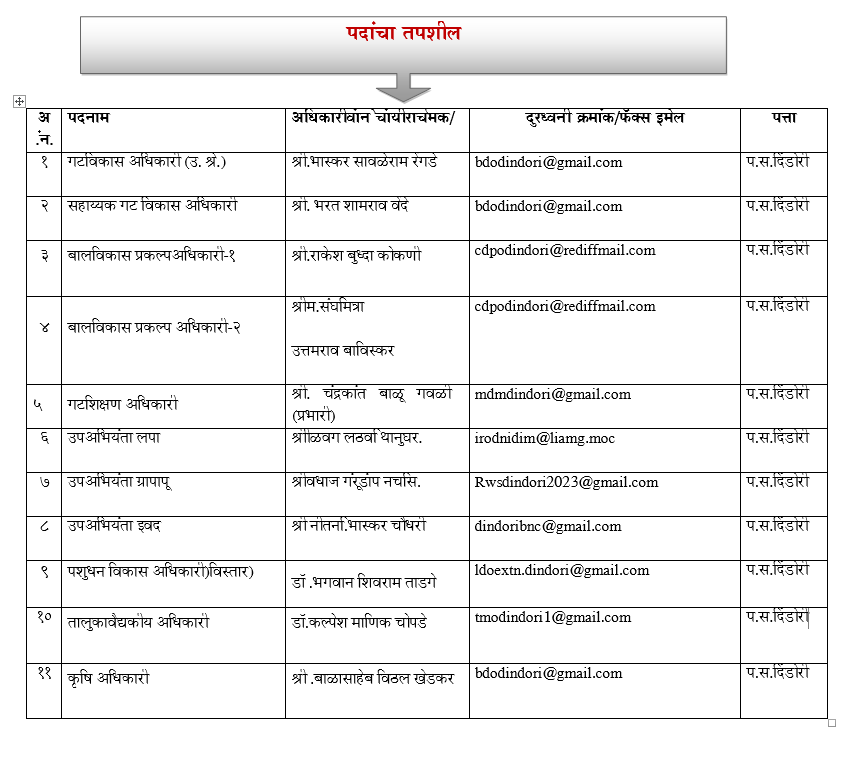
    PS Dindori

    • image (1)
      Bhaskar Savleram Rengade

      Block Development Officer

      Contact No- 8888608115

    • वेनदे सर
      Bharat Shamrav Vende

      Assistant Block Development Officer

      Contact No- 9423123745

    Dindori Taluka – Introduction

    In the eastern part of Dindori Taluka, Shri Kshetra Jopul is a well-known religious and pilgrimage center of the Warkari sect. It is famous as the birthplace and karmabhoomi (land of work) of Sant Patil Baba Maharaj. In the 18th century, Sant Patil Baba Maharaj worked to eradicate superstitions in the taluka and played a significant role in the expansion of the Warkari tradition. He also discovered the Samadhi of Saint Nivruttinath Maharaj.


    1) Geographical Location and Area

    • Coordinates: 20°12′00″ N, 73°49′59″ E
    • Source: “Dindori, India”, Falling Rain Genomics, Inc.
    • Total Area: 1342 sq. km

    2) Population

    As per the 2011 Census of India, Dindori Taluka has 58,271 households with a total population of 315,709, comprising 161,500 males and 154,209 females.
    The population of children in the 0–6 age group is 43,567, which constitutes 13.8% of the total population.


    3) Climate

    Summer extends from mid-March to early June. During summer, the climate is generally hot, with temperatures ranging between 38°C and 40°C. The monsoon season begins in mid-June and lasts until mid-October. Winter generally prevails from November to February. Overall, the climate is hot and uneven, with an average annual rainfall of up to 1,000 mm.

    The sex ratio of Dindori Taluka is approximately 955, compared to 929, which is close to the Maharashtra state average.
    The literacy rate of Dindori Taluka is 66.83%, of which 73.03% are male literates and 60.33% are female literates.
    The total area of Dindori Taluka is 1,318.75 sq. km, with a population density of 239 persons per sq. km.


    4) Political Information

    The Dindori Assembly Constituency is one of the 288 Vidhan Sabha constituencies in the state of Maharashtra, Western India. This constituency is reserved for Scheduled Tribes (ST).
    The Dindori Assembly Constituency forms part of the Dindori Lok Sabha Constituency, which also includes the Chandwad, Kalwan, Nandgaon, Niphad, and Yeola Assembly segments. All these constituencies are located within Nashik District.
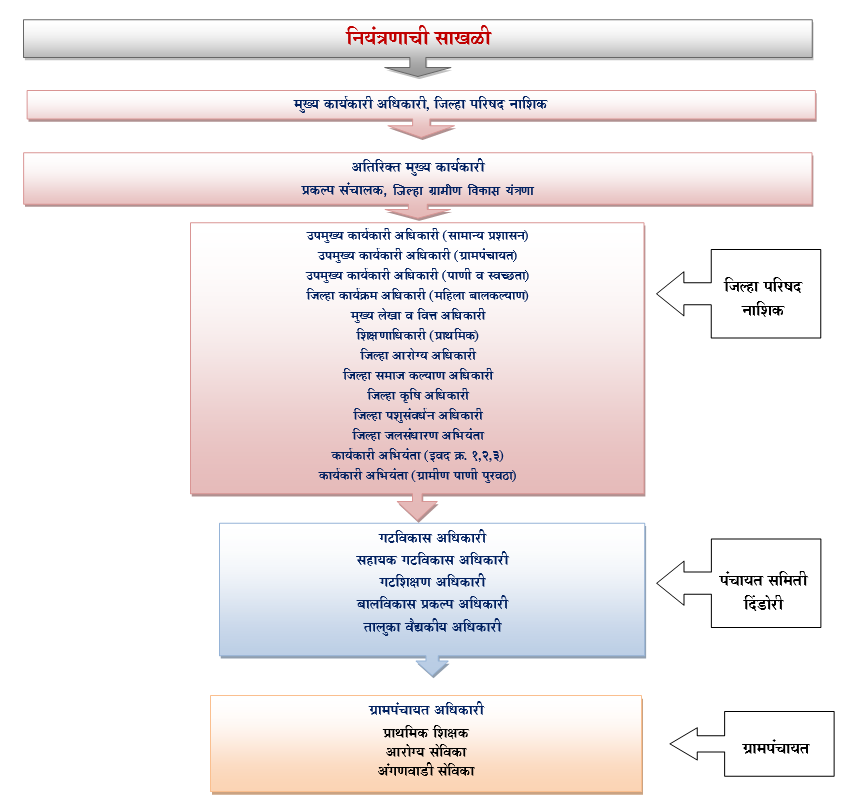
     

    Pradhan Mantri / Shabari / Ramai / Indira Awas Housing Scheme 2024–25

    Scheme Name: Ramai Housing Scheme

    1. Eligibility Conditions

    • Beneficiaries approved by the Gram Sabha.
    • Beneficiaries should not possess a permanent house.
    • The beneficiary should not have availed benefits of any housing scheme earlier.

    2. Eligibility Criteria

    1. Beneficiary must belong to the Scheduled Caste.
    2. Monthly family income should be below ₹10,000.
    3. No family member should have received housing benefits earlier.
    4. Approval of the beneficiary by the Gram Sabha is mandatory.
    5. Ownership of land or submission of consent letter is required.

    3. Procedure to Avail Benefits
    Eligible beneficiaries are selected as per targets allotted to the Gram Panchayat. Proposals received at the Panchayat Samiti level are scrutinized by the Assistant Commissioner, Social Welfare Department, Nashik. After verification, administrative approval is granted by the Project Director, District Rural Development Agency, Nashik. Subsequently, an amount of ₹1,20,000 is disbursed to the beneficiary in installments through the Panchayat Samiti office.

    4. Details of Benefits

    • ₹1,20,000 for house construction.
    • Wage assistance: ₹246 per day for 90 days, totaling ₹22,000, paid by the Government.

    5. Subsidy Disbursement Pattern (Online NEFT)

    • First Installment – House Sanctioned: ₹15,000
    • Second Installment – Plinth Level: ₹45,000
    • Third Installment – Lintel Level: ₹40,000
    • Final Installment – House Completed: ₹20,000

    6. Competent Authority
    Block Development Officer, Panchayat Samiti, Dindori

    7. Application Fee
    Free of cost

    8. Grievance Redressal Authority
    Block Development Officer, Panchayat Samiti, Dindori


    Mahatma Gandhi National Rural Employment Guarantee Scheme (MGNREGS) – Maharashtra (2024–25)

    Background

    The Maharashtra Employment Guarantee Act has been implemented since 1977. In 2005, the Government of India enacted the National Rural Employment Guarantee Act (now MGNREGA). Maharashtra adopted the Central Act with amendments, and currently the Maharashtra Employment Guarantee Act, 1977 (amended up to 6 August 2014) is in force.

    Schemes Under the Act

    A) MGNREGS – Maharashtra

    • Guaranteed 100 days of unskilled employment per household funded by the Central Government.
    • Employment beyond 100 days funded by the State Government.

    B) Individual Benefit Schemes (Section 12(E))

    • Irrigation well scheme
    • Fruit orchard plantation scheme

    Permissible Works Under MGNREGS

    Category A: Natural Resource Management (Public Works)

    • Water conservation and harvesting structures.
    • Minor irrigation works, canals, drainage, renovation of traditional water bodies.
    • Watershed development and afforestation activities.

    Category B: Individual Assets for Vulnerable Households

    • Land development, irrigation facilities, farm ponds.
    • Horticulture, sericulture, forestry.
    • Housing under Indira Awas Yojana (unskilled wage component).
    • Livestock infrastructure, poultry, goatery, cattle sheds.
    • Fisheries-related infrastructure.

    Category C: Infrastructure for Self-Help Groups (NRLM)

    • Storage facilities and livelihood infrastructure.
    • Common work sheds for SHGs.

    Category D: Rural Infrastructure

    • Sanitation facilities (ODF villages).
    • Rural roads, flood control works.
    • Community buildings (Anganwadi, SHG centers, markets, crematoriums).
    • Foodgrain storage buildings.
    • Maintenance of rural public assets.

    Key Features of MGNREGS – Maharashtra

    • Job card issued per household.
    • Equal wages for men and women.
    • Wage payment within 15 days.
    • Minimum 60% expenditure on unskilled labor.
    • No contractors or machinery permitted.
    • Employment within 5 km of the village.
    • Mandatory social audit and transparency.
    • Wages credited directly to bank/post office accounts.

    Facilities for Workers

    • Drinking water, first aid, and child care facilities at worksites.
    • Compensation in case of injury, disability, or death.
    • Unemployment allowance if work is not provided.

    Roles and Responsibilities

    Gram Panchayat

    • Registration of households.
    • Demand-based employment provision.
    • Planning and prioritization through Gram Sabha.
    • Conducting social audits.

    Panchayat Samiti

    • Coordination and supervision of Gram Panchayats.

    Zilla Parishad

    • District-level planning, coordination, and monitoring.

    Maharashtra State Rural Livelihood Mission (MSRLM)

    Sr. No. Scheme Financial Assistance Eligibility & Conditions Implementation
    1 MSRLM – Revolving Fund ₹15,000 (State) + ₹15,000 (Mission) SHG must be minimum 3 months old District Mission Management Unit, Nashik
    2 Bank Credit for SHGs ₹1 lakh to ₹10 lakh Loan application, bank documents Concerned Bank
    3 Community Investment Fund (CIF) ₹60,000 SHGs with approved MIP Cluster Federation / Village Organization


    Right to Information Act, 2005

    Introduction

    The implementation of the Right to Information Act, 2005 has brought effective control over government and semi-government authorities. This Act enables citizens to understand how government administration functions and how various public welfare schemes are implemented, including the different stages and procedures involved.

    As government functioning becomes more transparent, public doubts and suspicions are reduced. This Act also helps in curbing delays in official work and corruption.

    The Right to Information includes the following:

    • Inspection of works, documents, and records.
    • Obtaining certified copies of documents or records and taking notes from them.
    • Obtaining certified samples of material.
    • Obtaining information in the form of printouts, CDs, floppy disks, tapes, video records, or any other electronic mode.
      (Read More)

    Information Disclosure Table (As per Section 4 of RTI Act, 2005)

    Sr. No. Title Description Download
    1 Information under Section 4 of the RTI Act, 2005 (Points 1 to 17) Information as per Section 4 of the RTI Act, 2005 (Points 1 to 17) – Panchayat Samiti, Dindori View / Download


    Places of Interest

    1) Gadhi Ganpati

    Gadhi Ganpati is a historic temple of Lord Ganesha. The temple was established by Madhavrao Peshwa. It is believed to be a powerful and spiritually awakened (Jagrit) Ganesh temple. (Read More)

    2) Ramshej Fort

    Ramshej Fort, also known as Ramshesh Fort, is a small fort located about 10 kilometers (6.2 miles) from Dindori in Nashik district, Maharashtra, India. The fort holds historical importance. (Read More)

    3) Shri Kshetra Kardamashram (Karanji)

    Shri Kshetra Kardamashram is situated 10 km from Dindori and 6 km from Ozarkhed Dam. It is the sacred place of Mata Anusaya, the mother of Sage Atri and grandmother of Lord Dattatreya.
    Lord Shri Nrusimha Saraswati performed penance here for 12 years. Kardamashram is also known as “Prati-Ganagapur.” (Read More)

    4) Shri Kongai Mata

    The Kongai Mata Temple is a temple of Mata Bhavani, believed to have been established by Chhatrapati Shivaji Maharaj during the Surat campaign (Surat loot).

    5) Rantal

    Rantal is a historically significant place where a battle took place between Chhatrapati Shivaji Maharaj and the Mughals during the Surat campaign.

    6) Shri Saptashrungi Mata

    Shri Saptashrungi Mata is an Ardha Shakti Peeth of Goddess Durga, located approximately 55 km from Dindori. (Read More)


      • Email ID: panchayatsamitidindori@gmail.com.in
      • Contact Number of Group Development Officer: 8888608115
      • Contact Number of Assistant Group Development Officer: 9423123745
      • Contact Number of Panchayat Samiti: 7972406196